
Anxiety, insomnia, irritability, nervousness, restlessness, weakness, muscle cramps, hyperactivity, migraines… Sound familiar? These are symptoms of magnesium deficiency. Magnesium deficiency is easy to overlook because there really isn’t a specific syndrome attached to it. It’s estimated that about 80% of the population is magnesium deficient.
The amount of magnesium stored in the body is the least of the major minerals – we store about 35 grams in a 150 lb. person. It’s also something that get easily depleted by stress.
So what is magnesium? It is a mineral, like calcium and potassium. Magnesium is used by the body in over 300 enzyme reactions, like synthesis of proteins, RNA, and DNA. It helps with ATP formation, supports nerve transmission and relaxation of muscle tissue, and helps maintain healthy blood sugar levels.
So how do we lose it all? It’s excreted thru the kidneys and bowel. Alcohol, caffeine, and stress can accelerate magnesium loss. The body uses magnesium to buffer and help control the effects of stress hormones when they are released into the bloodstream. More stress = fewer magnesium reserves.
You can get it thru dark leafy greens, fermented soy, oats, nuts, meats, and sea vegetables. Or you can supplement. That’s what I choose.
There are quite a few absorbable forms: citrate, glycinate, malate, ionic, oxide, gluconate, and ascorbate. You can find what works best for you. If you are prescribed magnesium, it is almost always oxide. The oxide form and ascorbate will cause more loose stools than other forms – with the exception of liquid Mag Citrate (dynamite in a bottle).
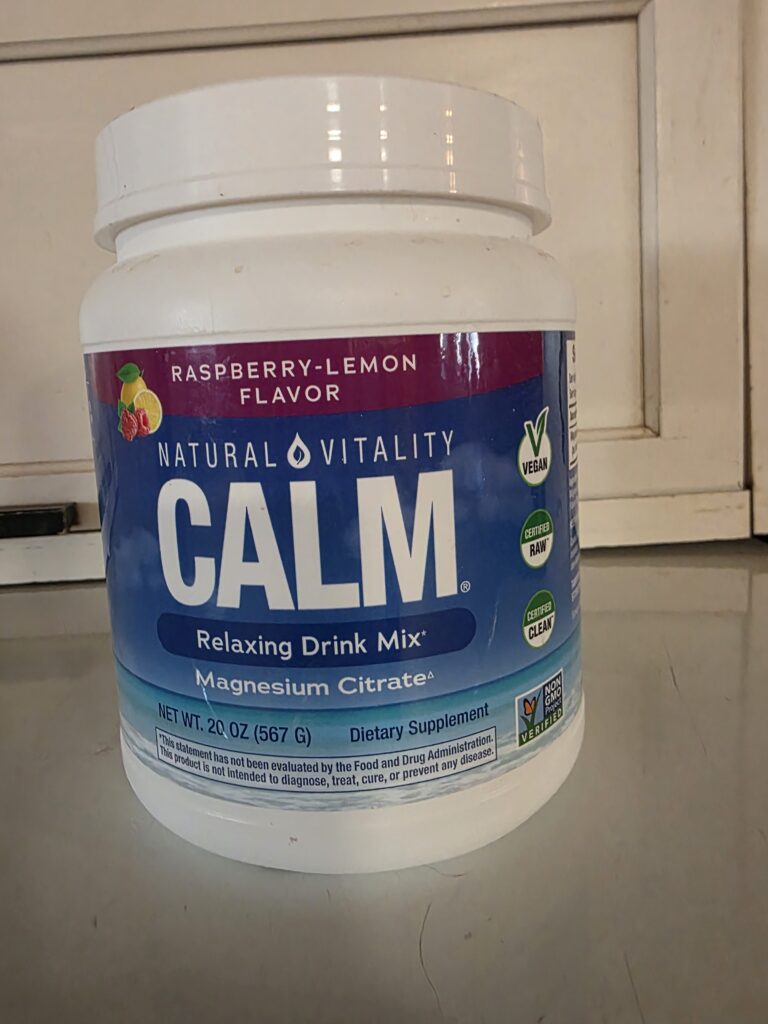
I use the CALM powder shown above. It is magnesium citrate in an ionic form and is easily titrated. The titration part is what I find most helpful. The instructions read 2 tsp per day. If you are starting magnesium supplementation – don’t do that. You won’t leave the bathroom and will leave me many mean messages on your phone while you’re stuck there. Start with maybe 1/2 tsp. in a cup of warm water, I prefer to take it at bedtime, as it really does help with relaxation. It’s not a sedative but does help muscles to settle down and for me, it helps my mind to settle as well.
Magnesium is also one of those things that you can’t really get too much of – your body will get rid of it (that’s why there is a laxative called Milk of Magnesia)!
Magnesium supplementation is something pretty easy and relatively cheap to add to your wellness routine. I can say that for me, turmeric and magnesium have made the biggest impact on my quality of life. Try it for yourself – it might be a game-changer for you, too.