
Around here the thistles are thick this year – tons down by the river and alongside county roads. They are just beautiful, and I’m sure all the local farmers and ranchers are cussing as they drive by them. The purple spiky flowers turn into seeds with a down-type thing and fly everywhere – meaning next year’s crop will be ten times what this year’s is.
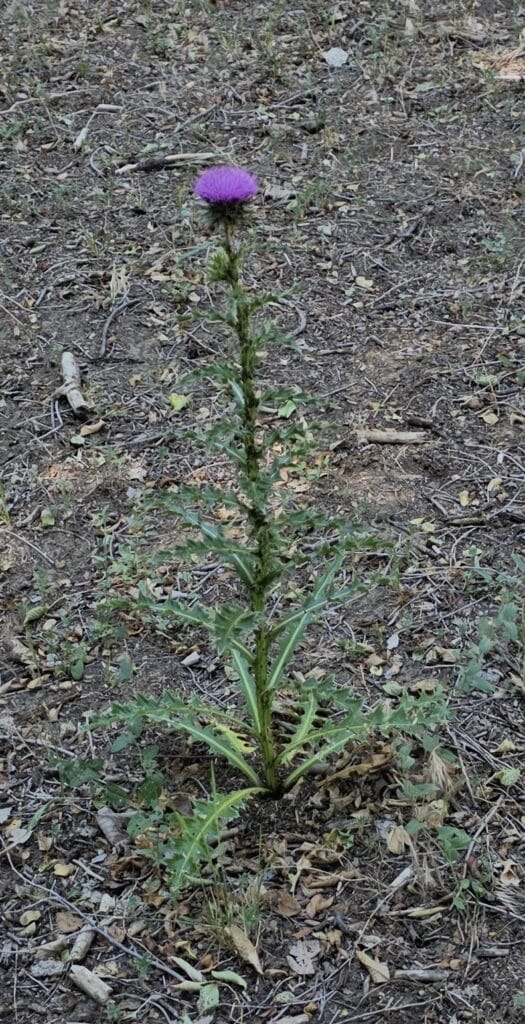
I love how Tim Scott describes this plant: “Anger is known to be an intimate expression of the liver, and being around this plant often provokes a livid reaction that is often coupled with profanities even in the most civilized and refined people.”
The “spp.” in the title is to indicate that I’m trying to cover multiple species – there are over 95 Cirsium species worldwide. Like milk thistle (Silybum marianum), the Cirsium group is amazing for the liver. Typically, the seeds are used, but all parts of the plant are useful. And the seeds are kind of a pain (literally) to harvest – worse than goatheads!
Thistle stems and roots are edible after the prickles have been removed, and the flower heads are a bit like artichokes (but require a lot more work to remove the bristles off the leaves).
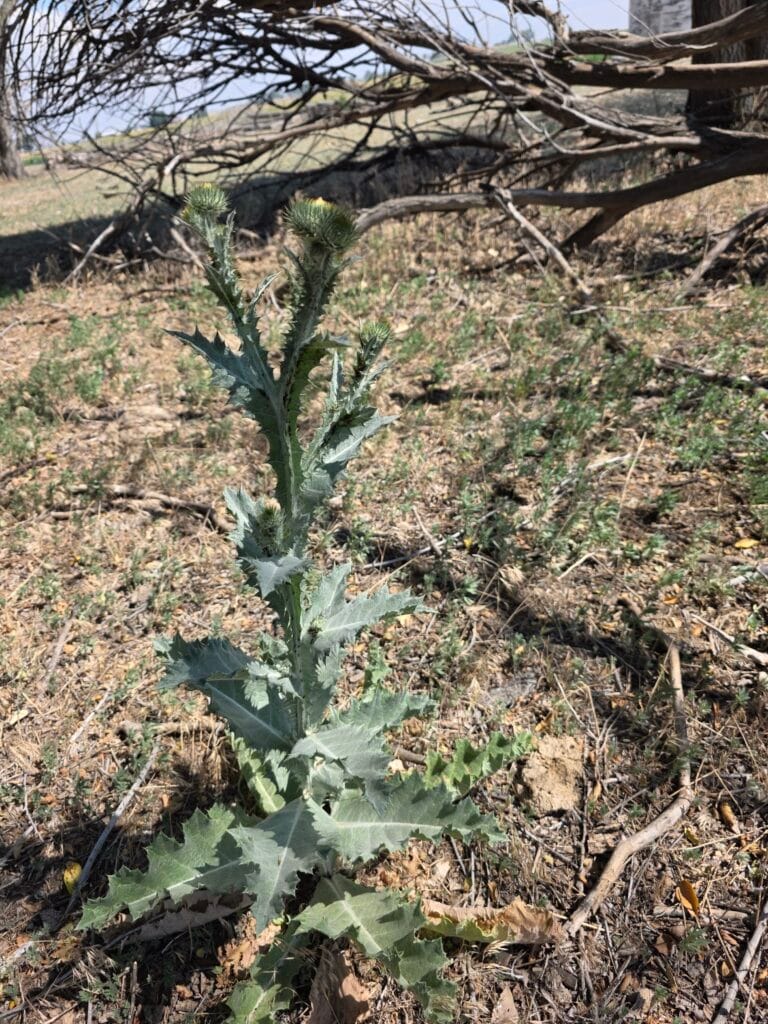
In our area, I see two main types: bull thistle (like the one above) has wider leaves, magenta flowers, and is taller (up to 8 feet). Canadian thistle has flowers that are more pink, smaller leaves and only grows about knee high. Both can be used in similar ways. While you can use the seeds (dried) as a tea or powder, if using the whole plant, I would make a tincture with fresh herb and 60% alcohol. Maybe when I finish the series on noxious weeds, I’ll do one on tincture making – how do any of my readers feel about that?
While thistle is primarily thought of as a ‘liver herb’, helping with detoxification, lowering blood pressure, and supporting liver function; it can also be very useful in disorders involving connective tissue like tendons and ligaments. One article I read had a study that showed thistle tincture could be as effective as some of the drugs like Humira and Enbrel. Granted it was a very small study – but the potential costs savings would make me try it if I needed to!
Thistle has no known contraindications that I could find, but I would never advise a pregnant woman to use herbs without the OK of her medical provider.
I’m still looking for some goatheads/puncture vine that have not been sprayed. If any of you out there have some, I’d be thrilled to take them.